By What (Single Step) Process Does Polonium-211 Decay to Lead-211 With One More Proton?
Affiliate 21. Nuclear Chemistry
21.3 Radioactive decay
Learning Objectives
Past the terminate of this section, you will be able to:
- Recognize common modes of radioactive disuse
- Identify common particles and energies involved in nuclear decay reactions
- Write and balance nuclear decay equations
- Calculate kinetic parameters for disuse processes, including half-life
- Depict mutual radiometric dating techniques
Following the somewhat serendipitous discovery of radioactivity by Becquerel, many prominent scientists began to investigate this new, intriguing phenomenon. Amid them were Marie Curie (the first woman to win a Nobel Prize, and the but person to win two Nobel Prizes in different sciences—chemistry and physics), who was the first to coin the term "radioactive decay," and Ernest Rutherford (of gilt foil experiment fame), who investigated and named three of the well-nigh mutual types of radiations. During the kickoff of the twentieth century, many radioactive substances were discovered, the properties of radiation were investigated and quantified, and a solid understanding of radiations and nuclear decay was adult.
The spontaneous alter of an unstable nuclide into another is radioactive decay. The unstable nuclide is called the parent nuclide; the nuclide that results from the decay is known as the daughter nuclide. The daughter nuclide may be stable, or it may disuse itself. The radiation produced during radioactive decay is such that the daughter nuclide lies closer to the band of stability than the parent nuclide, so the location of a nuclide relative to the band of stability can serve as a guide to the kind of decay it will undergo (Effigy ane).

Although the radioactivity of a nucleus is too small to see with the naked center, nosotros can indirectly view radioactivity in an environment called a cloud chamber. Click here to larn about cloud chambers and to view an interesting Deject Chamber Sit-in from the Jefferson Lab.
Types of Radioactive Decay
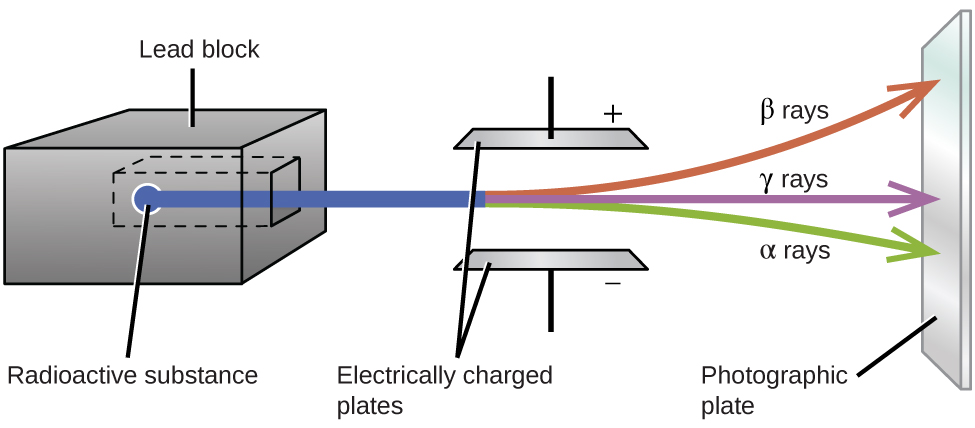
Ernest Rutherford's experiments involving the interaction of radiations with a magnetic or electrical field (Figure 2) helped him determine that 1 blazon of radiation consisted of positively charged and relatively massive α particles; a 2nd blazon was made upwards of negatively charged and much less massive β particles; and a third was uncharged electromagnetic waves, γ rays. We now know that α particles are high-free energy helium nuclei, β particles are loftier-energy electrons, and γ radiation compose high-energy electromagnetic radiation. We allocate dissimilar types of radioactive decay by the radiation produced.
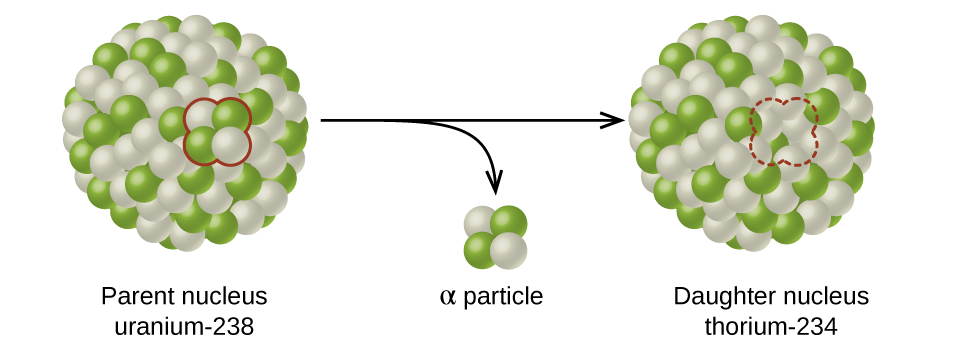
Blastoff (α) decay is the emission of an α particle from the nucleus. For instance, polonium-210 undergoes α decay:
[latex]_{84}^{210}\text{Po}\;{\longrightarrow}\;_2^4\text{He}\;+\;_{82}^{206}\text{Pb}\;\;\;\;\text{or}\;\;\;\;_{84}^{210}\text{Po}\;{\longrightarrow}\;_2^iv{\alpha}\;+\;_{82}^{206}\text{Pb}[/latex]
Alpha decay occurs primarily in heavy nuclei (A > 200, Z > 83). Considering the loss of an α particle gives a daughter nuclide with a mass number four units smaller and an diminutive number 2 units smaller than those of the parent nuclide, the daughter nuclide has a larger northward:p ratio than the parent nuclide. If the parent nuclide undergoing α decay lies below the band of stability (refer to Chapter 21.one Nuclear Structure and Stability), the daughter nuclide will lie closer to the band.
Beta (β) decay is the emission of an electron from a nucleus. Iodine-131 is an example of a nuclide that undergoes β disuse:
[latex]_{53}^{131}\text{I}\;{\longrightarrow}\;_{-ane}^0\text{due east}\;+\;_{54}^{131}\text{Xe}\;\;\;\;\text{or}\;\;\;\;_{53}^{131}\text{I}\;{\longrightarrow}\;_{-1}^0{\beta}\;+\;_{54}^{131}\text{Xe}[/latex]
Beta decay, which can exist idea of as the conversion of a neutron into a proton and a β particle, is observed in nuclides with a large north:p ratio. The beta particle (electron) emitted is from the diminutive nucleus and is not 1 of the electrons surrounding the nucleus. Such nuclei lie above the band of stability. Emission of an electron does not change the mass number of the nuclide only does increase the number of its protons and subtract the number of its neutrons. Consequently, the n:p ratio is decreased, and the girl nuclide lies closer to the band of stability than did the parent nuclide.
Gamma emission (γ emission) is observed when a nuclide is formed in an excited country and then decays to its ground land with the emission of a γ ray, a breakthrough of high-energy electromagnetic radiation. The presence of a nucleus in an excited state is often indicated by an asterisk (*). Cobalt-60 emits γ radiations and is used in many applications including cancer treatment:
[latex]_{27}^{60}\text{Co}^*\;{\longrightarrow}\;_0^0{\gamma}\;+\;_{27}^{lx}\text{Co}[/latex]
At that place is no change in mass number or atomic number during the emission of a γ ray unless the γ emission accompanies one of the other modes of decay.
Positron emission (β+ decay) is the emission of a positron from the nucleus. Oxygen-15 is an example of a nuclide that undergoes positron emission:
[latex]_8^{15}\text{O}\;{\longrightarrow}\;_{+1}^0\text{e}\;+\;_7^{fifteen}\text{North}\;\;\;\;\text{or}\;\;\;\;_8^{15}\text{O}\;{\longrightarrow}\;_{+1}^0{\beta}\;+\;_7^{xv}\text{N}[/latex]
Positron emission is observed for nuclides in which the n:p ratio is low. These nuclides lie beneath the band of stability. Positron decay is the conversion of a proton into a neutron with the emission of a positron. The northward:p ratio increases, and the daughter nuclide lies closer to the band of stability than did the parent nuclide.
Electron capture occurs when one of the inner electrons in an cantlet is captured by the atom'south nucleus. For case, potassium-40 undergoes electron capture:
[latex]_{19}^{40}\text{K}\;+\;_{-1}^0\text{e}\;{\longrightarrow}\;_{18}^{40}\text{Ar}[/latex]
Electron capture occurs when an inner shell electron combines with a proton and is converted into a neutron. The loss of an inner beat electron leaves a vacancy that will be filled by one of the outer electrons. As the outer electron drops into the vacancy, it volition emit energy. In almost cases, the free energy emitted volition be in the form of an X-ray. Like positron emission, electron capture occurs for "proton-rich" nuclei that lie below the band of stability. Electron capture has the same outcome on the nucleus every bit does positron emission: The atomic number is decreased past 1 and the mass number does not change. This increases the north:p ratio, and the daughter nuclide lies closer to the band of stability than did the parent nuclide. Whether electron capture or positron emission occurs is difficult to predict. The choice is primarily due to kinetic factors, with the one requiring the smaller activation energy being the ane more likely to occur.
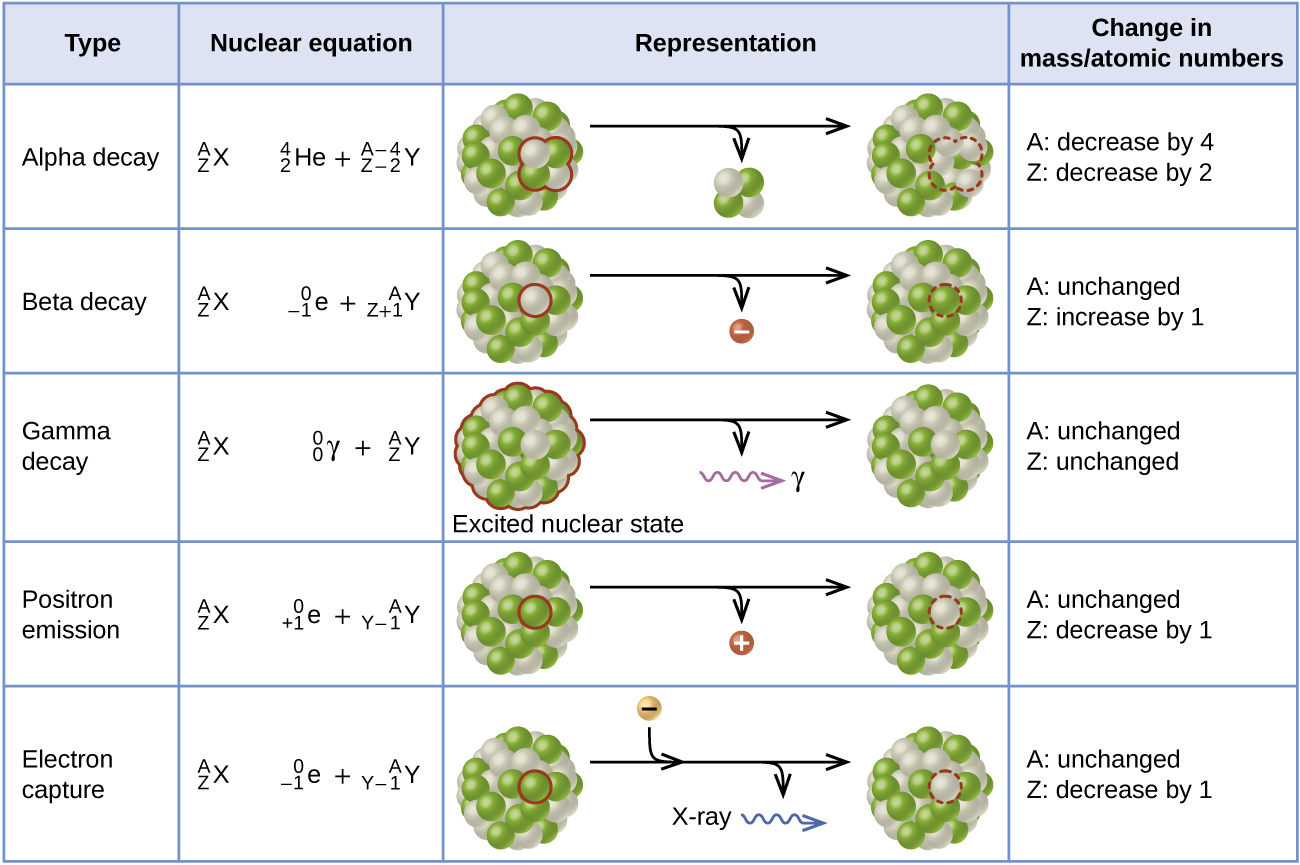
Figure 3 summarizes these types of disuse, forth with their equations and changes in diminutive and mass numbers.
PET Scan
Positron emission tomography (PET) scans use radiation to diagnose and runway health conditions and monitor medical treatments past revealing how parts of a patient's trunk part (Figure 4). To perform a PET browse, a positron-emitting radioisotope is produced in a cyclotron and then attached to a substance that is used by the part of the body being investigated. This "tagged" compound, or radiotracer, is then put into the patient (injected via IV or breathed in as a gas), and how it is used by the tissue reveals how that organ or other area of the body functions.
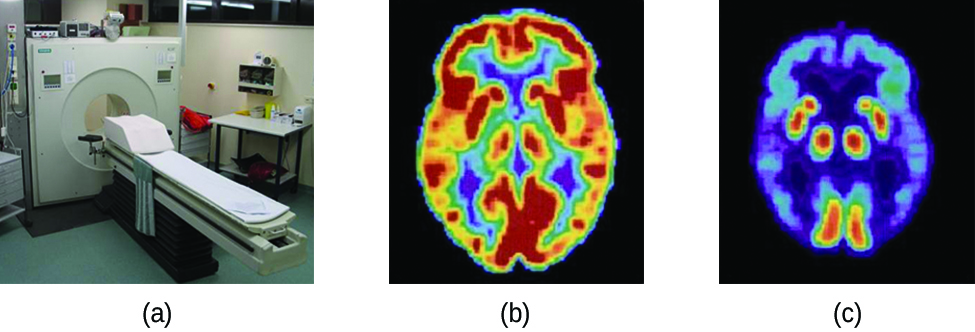
For example, F-18 is produced by proton bombardment of 18O ([latex]_8^{18}\text{O}\;+\;_1^i\text{p}\;{\longrightarrow}\;_9^{18}\text{F}\;+\;_0^1\text{due north}[/latex]) and incorporated into a glucose analog chosen fludeoxyglucose (FDG). How FDG is used past the body provides critical diagnostic information; for example, since cancers employ glucose differently than normal tissues, FDG can reveal cancers. The eighteenF emits positrons that interact with nearby electrons, producing a outburst of gamma radiation. This free energy is detected by the scanner and converted into a detailed, iii-dimensional, color image that shows how that part of the patient's trunk functions. Different levels of gamma radiation produce different amounts of brightness and colors in the epitome, which can then be interpreted by a radiologist to reveal what is going on. PET scans can notice center damage and heart illness, help diagnose Alzheimer'southward disease, signal the part of a encephalon that is affected past epilepsy, reveal cancer, show what stage it is, and how much information technology has spread, and whether treatments are effective. Different magnetic resonance imaging and X-rays, which only show how something looks, the big advantage of PET scans is that they show how something functions. PET scans are at present ordinarily performed in conjunction with a computed tomography scan.
Radioactivity Series
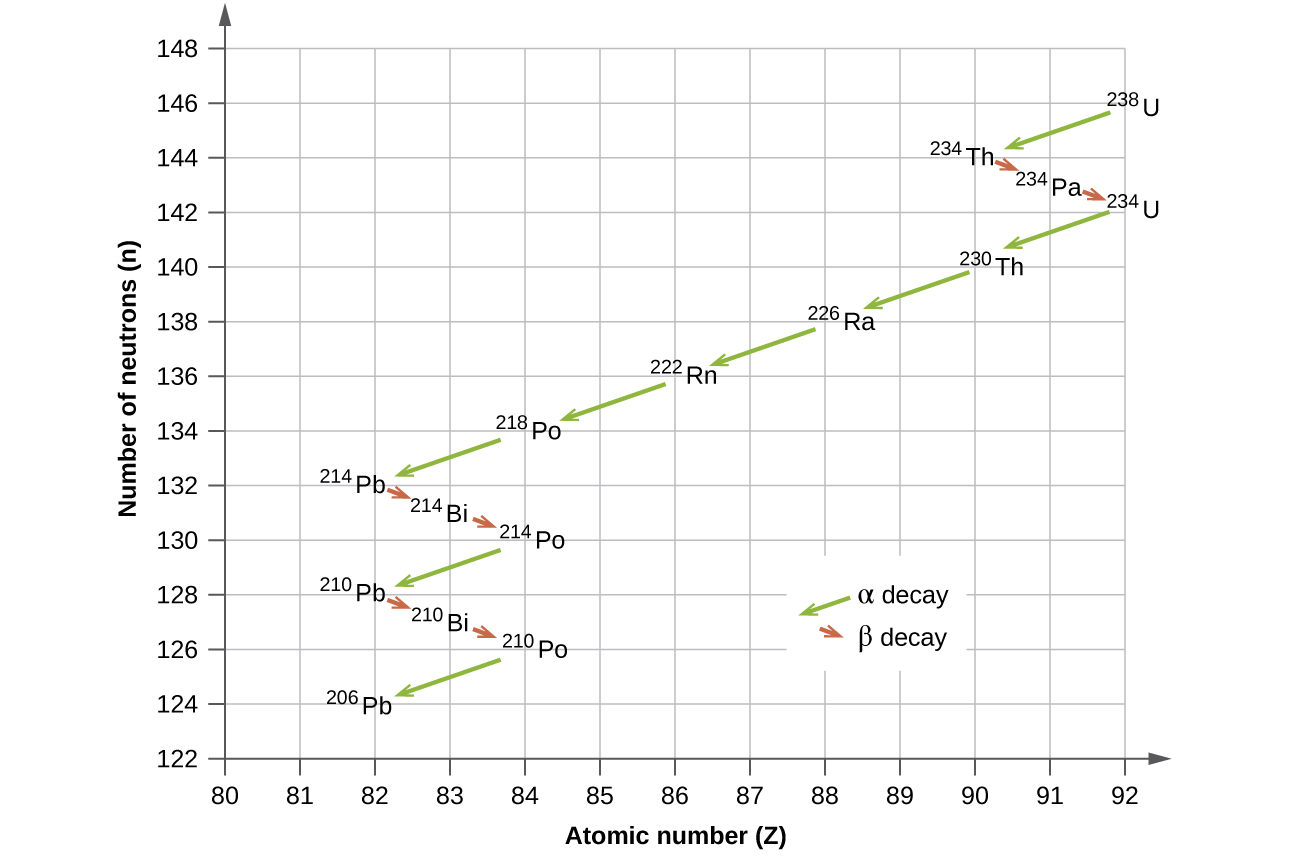
The naturally occurring radioactive isotopes of the heaviest elements fall into bondage of successive disintegrations, or decays, and all the species in i chain constitute a radioactive family, or radioactive decay series. Three of these series include most of the naturally radioactive elements of the periodic table. They are the uranium series, the actinide serial, and the thorium series. The neptunium serial is a fourth serial, which is no longer pregnant on the globe considering of the short half-lives of the species involved. Each serial is characterized by a parent (first member) that has a long half-life and a series of daughter nuclides that ultimately pb to a stable end-product—that is, a nuclide on the band of stability (Effigy 5). In all three series, the cease-product is a stable isotope of atomic number 82. The neptunium serial, previously thought to terminate with bismuth-209, terminates with thallium-205.
Radioactive Half-Lives
Radioactivity follows first-society kinetics. Since beginning-order reactions take already been covered in detail in the kinetics affiliate, we will now apply those concepts to nuclear decay reactions. Each radioactive nuclide has a characteristic, constant half-life (t 1/ii), the time required for half of the atoms in a sample to decay. An isotope'southward half-life allows usa to determine how long a sample of a useful isotope will be available, and how long a sample of an undesirable or dangerous isotope must be stored earlier it decays to a low-enough radiations level that is no longer a problem.
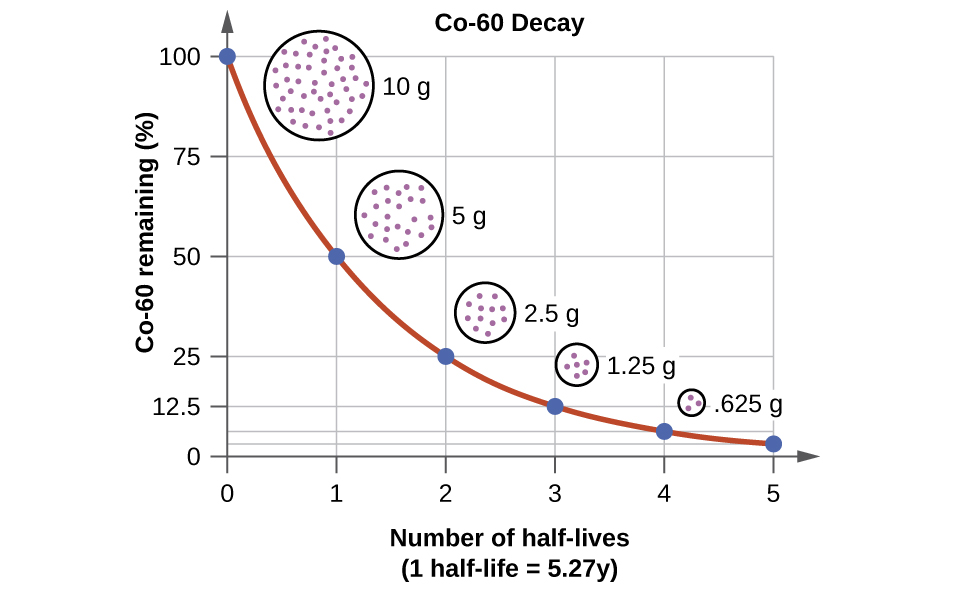
For example, cobalt-60, an isotope that emits gamma rays used to treat cancer, has a half-life of 5.27 years (Figure 6). In a given cobalt-threescore source, since half of the [latex]_{27}^{threescore}\text{Co}[/latex] nuclei decay every v.27 years, both the amount of material and the intensity of the radiation emitted is cut in one-half every 5.27 years. (Note that for a given substance, the intensity of radiation that it produces is direct proportional to the rate of decay of the substance and the amount of the substance.) This is as expected for a process following start-gild kinetics. Thus, a cobalt-60 source that is used for cancer treatment must be replaced regularly to continue to exist effective.
Since nuclear disuse follows first-order kinetics, nosotros can adapt the mathematical relationships used for starting time-order chemical reactions. We mostly substitute the number of nuclei, Northward, for the concentration. If the rate is stated in nuclear decays per 2d, we refer to information technology as the activity of the radioactive sample. The charge per unit for radioactive decay is:
disuse rate = λN with λ = the decay abiding for the particular radioisotope
The decay constant, λ, which is the same as a rate constant discussed in the kinetics affiliate. It is possible to express the decay constant in terms of the half-life, t 1/2:
[latex]{\lambda} = \frac{\text{ln}\;2}{t_{1/2}} = \frac{0.693}{t_{1/ii}}\;\;\;\;\text{or}\;\;\;\;t_{1/2} = \frac{\text{ln}\;2}{\lambda} = \frac{0.693}{\lambda}[/latex]
The first-order equations relating amount, N, and fourth dimension are:
[latex]N_t = N_0e^{-kt}\;\;\;\;\text{or}\;\;\;\;t = -\frac{1}{\lambda}\text{ln}(\frac{N_t}{N_0})[/latex]
where N 0 is the initial number of nuclei or moles of the isotope, and Northt is the number of nuclei/moles remaining at time t. Example 1 applies these calculations to find the rates of radioactive decay for specific nuclides.
Case 1
Rates of Radioactive Decay
[latex]_{27}^{lx}\text{Co}[/latex] decays with a half-life of 5.27 years to produce [latex]_{28}^{threescore}\text{Ni}[/latex].
(a) What is the disuse constant for the radioactive disintegration of cobalt-60?
(b) Calculate the fraction of a sample of the [latex]_{27}^{60}\text{Co}[/latex] isotope that will remain after 15 years.
(c) How long does it take for a sample of [latex]_{27}^{60}\text{Co}[/latex] to atomize to the extent that but 2.0% of the original amount remains?
Solution
(a) The value of the rate constant is given past:
[latex]{\lambda} = \frac{\text{ln}\;2}{t_{1/2}} = \frac{0.693}{5.27\text{y}} = 0.132\text{y}^{-1}[/latex]
(b) The fraction of [latex]_{27}^{60}\text{Co}[/latex] that is left after time t is given by [latex]\frac{N_t}{N_0}[/latex]. Rearranging the kickoff-club relationship [latex]N_t = N_0e^{-{\lambda}t}[/latex] to solve for this ratio yields:
[latex]\frac{N_t}{N_0} = e^{-{\lambda}t} = eastward^{-(0.132/\text{y})(15.0/\text{y})} = 0.138[/latex]
The fraction of [latex]_{27}^{60}\text{Co}[/latex] that will remain after 15.0 years is 0.138. Or put another way, 13.8% of the [latex]_{27}^{60}\text{Co}[/latex] originally present will remain afterwards fifteen years.
(c) 2.00% of the original amount of [latex]_{27}^{60}\text{Co}[/latex] is equal to [latex]0.0200 \times N_0[/latex]. Substituting this into the equation for time for first-order kinetics, nosotros take:
[latex]t = -\frac{1}{\lambda}\text{ln}(\frac{N_t}{N_0}) = -\frac{i}{0.132\text{y}^{-i}}\text{ln}(\frac{0.0200\;\times\;N_0}{N_0}) = 29.6\text{y}[/latex]
Check Your Learning
Radon-222, [latex]_{86}^{222}\text{Rn}[/latex], has a half-life of 3.823 days. How long will it take a sample of radon-222 with a mass of 0.750 g to disuse into other elements, leaving only 0.100 one thousand of radon-222?
Because each nuclide has a specific number of nucleons, a particular residual of repulsion and attraction, and its ain degree of stability, the half-lives of radioactive nuclides vary widely. For case: the half-life of [latex]_{83}^{209}\text{Bi}[/latex] is i.9 × 10nineteen years; [latex]_{94}^{239}\text{Ra}[/latex] is 24,000 years; [latex]_{86}^{222}\text{Rn}[/latex] is 3.82 days; and chemical element-111 (Rg for roentgenium) is one.v × x–3 seconds. The half-lives of a number of radioactive isotopes important to medicine are shown in Table 2, and others are listed in Appendix G.
| Type[1] | Decay Mode | Half-Life | Uses |
|---|---|---|---|
| F-xviii | β+ decay | 110. minutes | PET scans |
| Co-lx | β decay, γ decay | 5.27 years | cancer treatment |
| Tc-99m | γ decay | eight.01 hours | scans of brain, lung, heart, os |
| I-131 | β decay | 8.02 days | thyroid scans and treatment |
| Tl-201 | electron capture | 73 hours | eye and arteries scans; cardiac stress tests |
| Table 2. One-half-lives of Radioactive Isotopes Important to Medicine | |||
Radiometric Dating
Several radioisotopes accept half-lives and other backdrop that make them useful for purposes of "dating" the origin of objects such as archaeological artifacts, formerly living organisms, or geological formations. This process is radiometric dating and has been responsible for many breakthrough scientific discoveries about the geological history of the earth, the evolution of life, and the history of human civilization. We will explore some of the most common types of radioactive dating and how the detail isotopes work for each type.
Radioactive Dating Using Carbon-14
The radioactive decay of carbon-xiv provides a method for dating objects that were a role of a living organism. This method of radiometric dating, which is also called radiocarbon dating or carbon-14 dating, is accurate for dating carbon-containing substances that are upward to about 30,000 years old, and tin provide reasonably accurate dates up to a maximum of about 50,000 years erstwhile.
Naturally occurring carbon consists of iii isotopes: [latex]_6^{12}\text{C}[/latex], which constitutes about 99% of the carbon on world; [latex]_6^{xiii}\text{C}[/latex], near 1% of the full; and trace amounts of [latex]_6^{xiv}\text{C}[/latex]. Carbon-14 forms in the upper atmosphere by the reaction of nitrogen atoms with neutrons from catholic rays in space:
[latex]_7^{14}\text{N}\;+\;_0^i\text{n}\;{\longrightarrow}\;_6^{xiv}\text{C}\;+\;_1^1\text{H}[/latex]
All isotopes of carbon react with oxygen to produce COtwo molecules. The ratio of [latex]_6^{14}\text{CO}_2[/latex] to [latex]_6^{12}\text{CO}_2[/latex] depends on the ratio of [latex]_6^{14}\text{CO}[/latex] to [latex]_6^{12}\text{CO}[/latex] in the temper. The natural abundance of [latex]_6^{14}\text{CO}[/latex] in the temper is approximately 1 part per trillion; until recently, this has generally been abiding over time, equally seen is gas samples found trapped in ice. The incorporation of [latex]_6^{14}\text{CO}_2[/latex] and [latex]_6^{12}\text{CO}_2[/latex] into plants is a regular function of the photosynthesis process, which means that the [latex]_6^{14}\text{C}\;\text{:}\;_6^{12}\text{C}[/latex] ratio establish in a living plant is the same as the [latex]_6^{14}\text{C}\;\text{:}\;_6^{12}\text{C}[/latex] ratio in the atmosphere. But when the establish dies, it no longer traps carbon through photosynthesis. Because [latex]_6^{12}\text{C}[/latex] is a stable isotope and does not undergo radioactivity, its concentration in the plant does not alter. Notwithstanding, carbon-xiv decays past β emission with a half-life of 5730 years:
[latex]_6^{14}\text{C}\;{\longrightarrow}\;_7^{12}\text{Northward}\;+\;_{-i}^0\text{e}[/latex]
Thus, the [latex]_6^{14}\text{C}\;\text{:}\;_6^{12}\text{C}[/latex] ratio gradually decreases after the plant dies. The decrease in the ratio with fourth dimension provides a measure of the time that has elapsed since the death of the constitute (or other organism that ate the establish). Figure vii visually depicts this procedure.
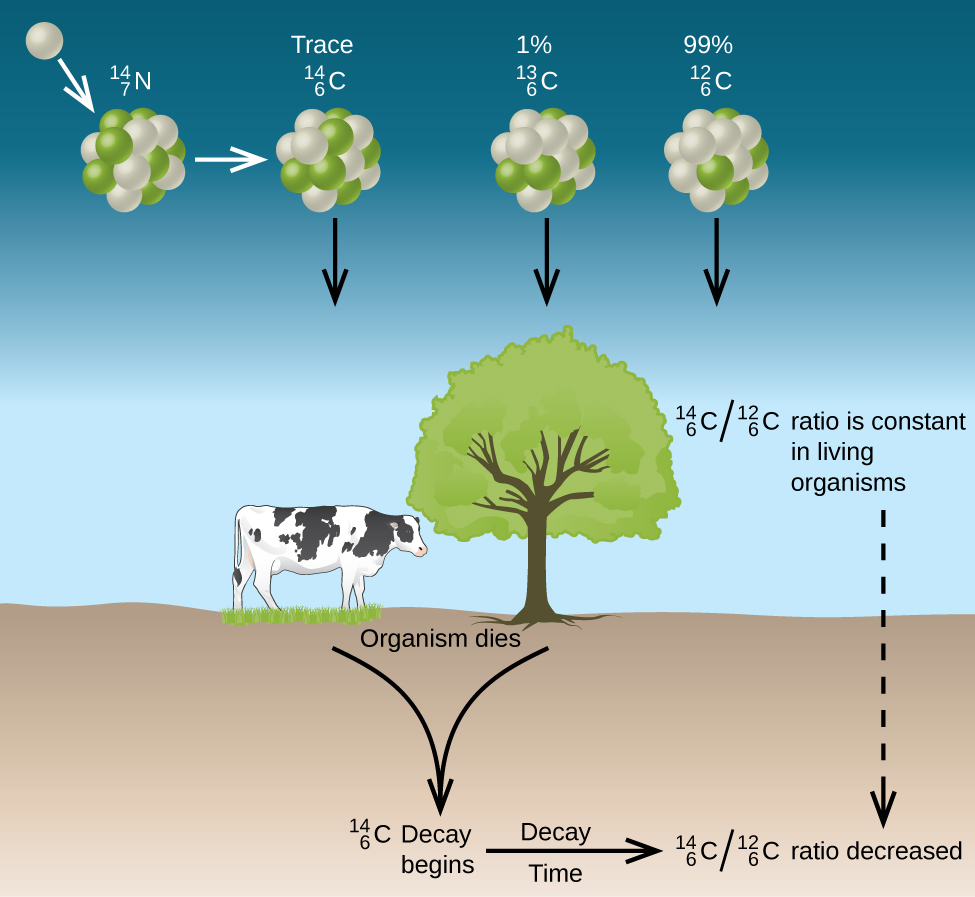
For example, with the half-life of [latex]_6^{fourteen}\text{C}[/latex] being 5730 years, if the [latex]_6^{14}\text{C}\;\text{:}\;_6^{12}\text{C}[/latex] ratio in a wooden object institute in an archaeological dig is half what it is in a living tree, this indicates that the wooden object is 5730 years old. Highly authentic determinations of [latex]_6^{14}\text{C}\;\text{:}\;_6^{12}\text{C}[/latex] ratios can be obtained from very small samples (equally niggling every bit a milligram) by the utilize of a mass spectrometer.
Visit this website to perform simulations of radiometric dating.
Example 2
Radiocarbon Dating
A tiny slice of newspaper (produced from formerly living plant matter) taken from the Expressionless Sea Scrolls has an activity of 10.8 disintegrations per minute per gram of carbon. If the initial C-14 activity was 13.6 disintegrations/min/thou of C, gauge the historic period of the Dead Bounding main Scrolls.
Solution
The rate of decay (number of disintegrations/infinitesimal/gram of carbon) is proportional to the amount of radioactive C-14 left in the paper, and so we can substitute the rates for the amounts, N, in the relationship:
$latex t = -\frac{1}{\lambda}\text{ln}(\frac{N_t}{N_0})\;{\longrightarrow}\;t = -\frac{1}{\lambda}\
;\text{ln}\;(\frac{\text{Rate}_t}{\text{Charge per unit}_0})$
where the subscript 0 represents the time when the plants were cut to make the paper, and the subscript t represents the current time.
The disuse abiding can be adamant from the half-life of C-fourteen, 5730 years:
[latex]{\lambda} = \frac{\text{ln}\;2}{t_{1/2}} = \frac{0.693}{5730\;\text{y}} = 1.21\;\times\;x^{-four}\text{y}^{-1}[/latex]
Substituting and solving, we have:
[latex]t = -\frac{ane}{\lambda}\;\text{ln}\;(\frac{\text{Rate}_t}{\text{Rate}_0}) = -\frac{1}{ane.21\;\times\;ten^{-4}\text{y}^{-one}}\;\text{ln}\;(\frac{x.viii\;\text{dis/min/g\;C}}{13.vi\;\text{dis/min/g\;C}}) = 1910\text{y}[/latex]
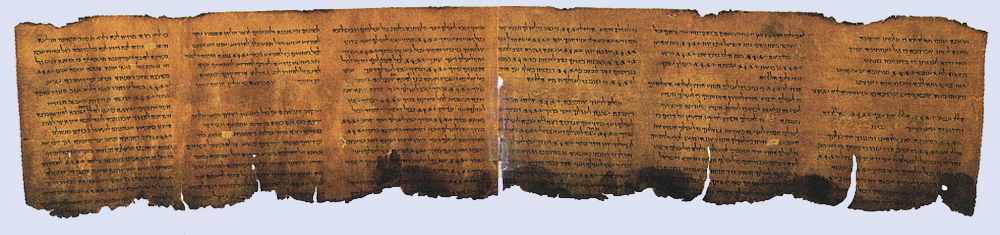
Therefore, the Expressionless Sea Scrolls are approximately 1900 years old (Figure viii).
Cheque Your Learning
More accurate dates of the reigns of aboriginal Egyptian pharaohs have been determined recently using plants that were preserved in their tombs. Samples of seeds and plant matter from Male monarch Tutankhamun's tomb accept a C-14 decay charge per unit of 9.07 disintegrations/min/g of C. How long ago did Rex Tut's reign come to an end?
Answer:
about 3350 years ago, or approximately 1340 BC
There have been some meaning, well-documented changes to the [latex]_6^{14}\text{C}\;\text{:}\;_6^{12}\text{C}[/latex] ratio. The accurateness of a straightforward application of this technique depends on the [latex]_6^{fourteen}\text{C}\;\text{:}\;_6^{12}\text{C}[/latex] ratio in a living institute being the same at present equally it was in an earlier era, but this is not always valid. Due to the increasing accumulation of COii molecules (largely [latex]_6^{12}\text{CO}_2[/latex]) in the atmosphere caused by combustion of fossil fuels (in which essentially all of the [latex]_6^{xiv}\text{C}[/latex] has decayed), the ratio of [latex]_6^{fourteen}\text{C}\;\text{:}\;_6^{12}\text{C}[/latex] in the atmosphere may be changing. This manmade increase in [latex]_6^{12}\text{CO}_2[/latex] in the atmosphere causes the [latex]_6^{14}\text{C}\;\text{:}\;_6^{12}\text{C}[/latex] ratio to decrease, and this in plough affects the ratio in currently living organisms on the earth. Fortunately, however, we can apply other information, such as tree dating via examination of annual growth rings, to calculate correction factors. With these correction factors, accurate dates can exist determined. In general, radioactive dating only works for well-nigh 10 half-lives; therefore, the limit for carbon-14 dating is virtually 57,000 years.
Radioactive Dating Using Nuclides Other than Carbon-fourteen
Radioactive dating can as well utilise other radioactive nuclides with longer half-lives to date older events. For example, uranium-238 (which decays in a series of steps into atomic number 82-206) tin be used for establishing the age of rocks (and the approximate age of the oldest rocks on earth). Since U-238 has a one-half-life of 4.5 billion years, information technology takes that amount of time for half of the original U-238 to decay into Pb-206. In a sample of rock that does non incorporate appreciable amounts of Pb-208, the almost abundant isotope of lead, we can presume that atomic number 82 was non present when the rock was formed. Therefore, by measuring and analyzing the ratio of U-238:Pb-206, we can determine the age of the rock. This assumes that all of the pb-206 present came from the decay of uranium-238. If in that location is additional lead-206 nowadays, which is indicated by the presence of other atomic number 82 isotopes in the sample, it is necessary to make an adjustment. Potassium-argon dating uses a like method. Thou-twoscore decays by positron emission and electron capture to grade Ar-xl with a half-life of 1.25 billion years. If a stone sample is crushed and the corporeality of Ar-forty gas that escapes is measured, determination of the Ar-40:One thousand-40 ratio yields the age of the stone. Other methods, such as rubidium-strontium dating (Rb-87 decays into Sr-87 with a half-life of 48.eight billion years), operate on the same principle. To approximate the lower limit for the earth'south age, scientists determine the age of diverse rocks and minerals, making the assumption that the earth is older than the oldest rocks and minerals in its crust. As of 2014, the oldest known rocks on earth are the Jack Hills zircons from Australia, found by uranium-lead dating to be almost 4.4 billion years old.
Case 3
Radioactive Dating of Rocks
An igneous rock contains 9.58 × 10⁻⁵ g of U-238 and ii.51 × 10–5 g of Pb-206, and much, much smaller amounts of Pb-208. Determine the estimate time at which the stone formed.
Solution
The sample of rock contains very little Lead-208, the almost common isotope of lead, and then we can safely assume that all the Pb-206 in the rock was produced by the radioactivity of U-238. When the rock formed, it contained all of the U-238 currently in it, plus some U-238 that has since undergone radioactive decay.
The amount of U-238 currently in the rock is:
[latex]ix.58\;\times\;10^{-five}\rule[0.5ex]{1.5em}{0.1ex}\hspace{-i.5em}\text{thousand\;U}\;\times\;(\frac{one\;\text{mol\;U}}{238\;\rule[0.25ex]{1em}{0.1ex}\hspace{-1em}\text{k\;U}}) = iv.03\;\times\;ten^{-7}\text{mol\;U}[/latex]
Because when one mole of U-238 decays, information technology produces ane mole of Pb-206, the amount of U-238 that has undergone radioactive disuse since the stone was formed is:
[latex]2.51\;\times\;10^{-v}\rule[0.5ex]{2em}{0.1ex}\hspace{-2em}\text{thousand\;Lead}\;\times\;(\frac{1\;\rule[0.25ex]{2.35em}{0.1ex}\hspace{-ii.35em}\text{mol\;Pb}}{206\;\rule[0.25ex]{i.35em}{0.1ex}\hspace{-1.35em}\text{g\;Pb}})\;\times\;(\frac{one\;\text{mol\;U}}{1\;\rule[0.25ex]{two.35em}{0.1ex}\hspace{-2.35em}\text{mol\;Pb}}) = 1.22\;\times\;ten^{-7}\;\text{mol\;U}[/latex]
The total amount of U-238 originally present in the stone is therefore:
[latex]4.03\;\times\;10^{-7}\;\text{mol}\;+\;1.22\;\times\;10^{-7}\;\text{mol} = 5.25\;\times\;10^{-vii}\;\text{mol\;U}[/latex]
The amount of time that has passed since the formation of the rock is given by:
[latex]t = -\frac{1}{\lambda}\;\text{ln}\;(\frac{N_t}{N_0})[/latex]
with N 0 representing the original amount of U-238 and Due northt representing the nowadays amount of U-238.
U-238 decays into Atomic number 82-206 with a half-life of 4.5 × 10⁹ y, and then the decay abiding λ is:
[latex]{\lambda} = \frac{\text{ln}\;2}{t_{ane/2}} = \frac{0.693}{4.v\;\times\;10^9\;\text{y}} = i.54\;\times\;x^{-10}\text{y}^{-1}[/latex]
Substituting and solving, we have:
[latex]t = -\frac{i}{1.54\;\times\;10^{-ten}\text{y}^{-1}}\text{ln}(\frac{4.03\;\times\;ten^{-7}\;\rule[0.25ex]{ane.9em}{0.1ex}\hspace{-1.9em}\text{mol\;U}}{v.25\;\times\;10^{-vii}\;\rule[0.25ex]{1.9em}{0.1ex}\hspace{-ane.9em}\text{mol\;U}}) = ane.vii\;\times\;10^nine\text{y}[/latex]
Therefore, the rock is approximately one.seven billion years erstwhile.
Cheque Your Learning
A sample of rock contains half-dozen.xiv × ten–iv g of Rb-87 and 3.51 × 10⁻⁵ thou of Sr-87. Calculate the age of the rock. (The half-life of the β decay of Rb-87 is four.7 × 1010 y.)
Key Concepts and Summary
Nuclei that have unstable n:p ratios undergo spontaneous radioactivity. The most common types of radioactivity are α decay, β decay, γ emission, positron emission, and electron capture. Nuclear reactions besides often involve γ rays, and some nuclei decay by electron capture. Each of these modes of decay leads to the formation of a new nucleus with a more stable north:p ratio. Some substances undergo radioactive decay serial, proceeding through multiple decays earlier ending in a stable isotope. All nuclear decay processes follow first-society kinetics, and each radioisotope has its ain feature half-life, the fourth dimension that is required for half of its atoms to decay. Because of the big differences in stability among nuclides, there is a very wide range of half-lives of radioactive substances. Many of these substances have found useful applications in medical diagnosis and treatment, determining the historic period of archaeological and geological objects, and more than.
Key Equations
- disuse rate = λN
- [latex]t_{1/2} = \frac{\text{ln}\;2}{\lambda} = \frac{0.693}{\lambda}[/latex]
Chemical science Stop of Chapter Exercises
- What are the types of radiation emitted by the nuclei of radioactive elements?
- What changes occur to the diminutive number and mass of a nucleus during each of the following decay scenarios?
(a) an α particle is emitted
(b) a β particle is emitted
(c) γ radiation is emitted
(d) a positron is emitted
(e) an electron is captured
- What is the modify in the nucleus that results from the following decay scenarios?
(a) emission of a β particle
(b) emission of a β+ particle
(c) capture of an electron
- Many nuclides with atomic numbers greater than 83 disuse past processes such equally electron emission. Explain the ascertainment that the emissions from these unstable nuclides also normally include α particles.
- Why is electron capture accompanied by the emission of an Ten-ray?
- Explain, in terms of Nuclear Structure and Stability, how unstable heavy nuclides (atomic number > 83) may decompose to class nuclides of greater stability (a) if they are beneath the band of stability and (b) if they are above the band of stability.
- Which of the following nuclei is virtually likely to decay past positron emission? Explicate your option.
(a) chromium-53
(b) manganese-51
(c) atomic number 26-59
- The following nuclei do not prevarication in the band of stability. How would they exist expected to decay? Explicate your answer.
(a) [latex]_{15}^{34}\text{P}[/latex]
(b) [latex]_{92}^{239}\text{U}[/latex]
(c) [latex]_{20}^{38}\text{Ca}[/latex]
(d) [latex]_1^3\text{H}[/latex]
(e) [latex]_{94}^{245}\text{Pu}[/latex]
- The following nuclei exercise non lie in the band of stability. How would they exist expected to decay?
(a) [latex]_{15}^{28}\text{P}[/latex]
(b) [latex]_{92}^{235}\text{U}[/latex]
(c) [latex]_{20}^{37}\text{Ca}[/latex]
(d) [latex]_3^ix\text{Li}[/latex]
(e) [latex]_{96}^{245}\text{Cm}[/latex]
- Predict by what style(s) of spontaneous radioactive decay each of the following unstable isotopes might proceed:
(a) [latex]_2^6\text{He}[/latex]
(b) [latex]_{30}^{60}\text{Zn}[/latex]
(c) [latex]_{91}^{235}\text{Pa}[/latex]
(d) [latex]_{94}^{241}\text{Np}[/latex]
(e) [latex]^{18}\text{F}[/latex]
(f) [latex]^{129}\text{Ba}[/latex]
(m) [latex]^{237}\text{Pu}[/latex]
- Write a nuclear reaction for each step in the formation of [latex]_{84}^{218}\text{Po}[/latex] from [latex]_{98}^{238}\text{U}[/latex], which proceeds past a series of decay reactions involving the step-wise emission of α, β, β, α, α, α particles, in that order.
- Write a nuclear reaction for each step in the germination of [latex]_{82}^{208}\text{Pb}[/latex] from [latex]_{90}^{228}\text{Th}[/latex], which proceeds by a series of decay reactions involving the pace-wise emission of α, α, α, α, β, β, α particles, in that gild.
- Define the term half-life and illustrate information technology with an example.
- A 1.00 × 10⁻⁶-grand sample of nobelium, [latex]_{102}^{254}\text{No}[/latex], has a half-life of 55 seconds subsequently information technology is formed. What is the percentage of [latex]_{102}^{254}\text{No}[/latex] remaining at the following times?
(a) 5.0 min later on it forms
(b) 1.0 h after it forms
- [latex]^{239}\text{Pu}[/latex] is a nuclear waste byproduct with a half-life of 24,000 y. What fraction of the [latex]^{239}\text{Pu}[/latex] present today volition be present in 1000 y?
- The isotope [latex]^{208}\text{Tl}[/latex] undergoes β disuse with a one-half-life of 3.1 min.
(a) What isotope is produced past the disuse?
(b) How long will information technology take for 99.0% of a sample of pure [latex]^{208}\text{Tl}[/latex] to decay?
(c) What percentage of a sample of pure [latex]^{208}\text{Tl}[/latex] remains un-decayed after 1.0 h?
- If i.000 grand of [latex]_{88}^{226}\text{Ra}[/latex] produces 0.0001 mL of the gas [latex]_{86}^{222}\text{Rn}[/latex] at STP (standard temperature and pressure) in 24 h, what is the half-life of [latex]^{226}\text{Ra}[/latex] in years?
- The isotope [latex]_{38}^{xc}\text{Sr}[/latex] is one of the extremely chancy species in the residues from nuclear ability generation. The strontium in a 0.500-k sample diminishes to 0.393 g in x.0 y. Calculate the half-life.
- Technetium-99 is often used for assessing middle, liver, and lung impairment because sure technetium compounds are absorbed past damaged tissues. It has a half-life of half-dozen.0 h. Summate the rate abiding for the decay of [latex]_{43}^{99}\text{Tc}[/latex].
- What is the age of mummified primate peel that contains viii.25% of the original quantity of [latex]^{14}\text{C}[/latex]?
- A sample of rock was constitute to contain 8.23 mg of rubidium-87 and 0.47 mg of strontium-87.
(a) Calculate the age of the rock if the half-life of the disuse of rubidium by β emission is 4.vii × 1010 y.
(b) If some [latex]_{38}^{87}\text{Sr}[/latex] was initially present in the rock, would the rock be younger, older, or the same age equally the historic period calculated in (a)? Explain your answer.
- A laboratory investigation shows that a sample of uranium ore contains 5.37 mg of [latex]_{92}^{238}\text{U}[/latex] and 2.52 mg of [latex]_{82}^{206}\text{Pb}[/latex]. Calculate the age of the ore. The half-life of [latex]_{92}^{238}\text{U}[/latex] is 4.5 × x9 yr.
- Plutonium was detected in trace amounts in natural uranium deposits past Glenn Seaborg and his associates in 1941. They proposed that the source of this [latex]^{239}\text{Pu}[/latex] was the capture of neutrons by [latex]^{238}\text{U}[/latex] nuclei. Why is this plutonium non likely to take been trapped at the time the solar system formed 4.7 × x9 years ago?
- A [latex]_4^7\text{Be}[/latex] cantlet (mass = 7.0169 amu) decays into a [latex]_3^7\text{Li}[/latex] cantlet (mass = vii.0160 amu) by electron capture. How much energy (in millions of electron volts, MeV) is produced past this reaction?
- A [latex]_5^viii\text{B}[/latex] cantlet (mass = 8.0246 amu) decays into a [latex]_4^8\text{B}[/latex] atom (mass = 8.0053 amu) by loss of a β+ particle (mass = 0.00055 amu) or by electron capture. How much energy (in millions of electron volts) is produced by this reaction?
- Isotopes such as [latex]^{26}\text{Al}[/latex] (half-life: 7.ii × x5 years) are believed to have been present in our solar system as it formed, but have since decayed and are now called extinct nuclides.
(a) [latex]^{26}\text{Al}[/latex] decays by β+ emission or electron capture. Write the equations for these two nuclear transformations.
(b) The globe was formed about 4.7 × 10⁹ (4.7 billion) years agone. How former was the earth when 99.999999% of the [latex]^{26}\text{Al}[/latex] originally present had decayed?
- Write a counterbalanced equation for each of the following nuclear reactions:
(a) bismuth-212 decays into polonium-212
(b) beryllium-8 and a positron are produced by the decay of an unstable nucleus
(c) neptunium-239 forms from the reaction of uranium-238 with a neutron then spontaneously converts into plutonium-239
(d) strontium-90 decays into yttrium-ninety
- Write a balanced equation for each of the following nuclear reactions:
(a) mercury-180 decays into platinum-176
(b) zirconium-xc and an electron are produced by the decay of an unstable nucleus
(c) thorium-232 decays and produces an alpha particle and a radium-228 nucleus, which decays into actinium-228 by beta decay
(d) neon-xix decays into fluorine-19
Glossary
- alpha (α) decay
- loss of an blastoff particle during radioactive decay
- beta (β) decay
- breakdown of a neutron into a proton, which remains in the nucleus, and an electron, which is emitted as a beta particle
- daughter nuclide
- nuclide produced past the radioactive decay of another nuclide; may exist stable or may decay further
- electron capture
- combination of a core electron with a proton to yield a neutron within the nucleus
- gamma (γ) emission
- decay of an excited-state nuclide accompanied past emission of a gamma ray
- half-life (t one/2)
- time required for half of the atoms in a radioactive sample to disuse
- parent nuclide
- unstable nuclide that changes spontaneously into another (daughter) nuclide
- positron emission
- (as well, β+ decay) conversion of a proton into a neutron, which remains in the nucleus, and a positron, which is emitted
- radioactive decay
- spontaneous decay of an unstable nuclide into another nuclide
- radioactive decay series
- chains of successive disintegrations (radioactive decays) that ultimately lead to a stable stop-product
- radiocarbon dating
- highly accurate means of dating objects 30,000–fifty,000 years old that were derived from once-living matter; accomplished by calculating the ratio of 614C:612C614C:612C in the object vs. the ratio of 614C:612C614C:612C in the present-day temper
- radiometric dating
- apply of radioisotopes and their properties to date the formation of objects such equally archeological artifacts, formerly living organisms, or geological formations
Solutions
Answers to Chemistry Terminate of Chapter Exercises
1. α (helium nuclei), β (electrons), β+ (positrons), and η (neutrons) may exist emitted from a radioactive element, all of which are particles; γ rays besides may exist emitted.
3. (a) conversion of a neutron to a proton: [latex]_0^1\text{due north}{\longrightarrow}_1^1\text{p}\;+\;_{+1}^0\text{e};[/latex] (b) conversion of a proton to a neutron; the positron has the aforementioned mass every bit an electron and the same magnitude of positive charge as the electron has negative charge; when the north:p ratio of a nucleus is too low, a proton is converted into a neutron with the emission of a positron: [latex]_1^i\text{p}{\longrightarrow}_0^1\text{due north}\;+\;_{+i}^0\text{east};[/latex] (c) In a proton-rich nucleus, an inner atomic electron can be absorbed. In simplest form, this changes a proton into a neutron: [latex]_1^1\text{p}\;+\;_{-i}^0\text{e}{\longrightarrow}_0^1\text{p}[/latex]
five. The electron pulled into the nucleus was most probable establish in the anesouthward orbital. As an electron falls from a college free energy level to replace it, the difference in the energy of the replacement electron in its two energy levels is given off as an Ten-ray.
7. Manganese-51 is virtually probable to decay by positron emission. The n:p ratio for Cr-53 is [latex]\frac{29}{24} = i.21[/latex]; for Mn-51, it is [latex]\frac{26}{25} = 1.04[/latex]; for Fe-59, information technology is [latex]\frac{33}{26} = one.27[/latex]. Positron disuse occurs when the n:p ratio is depression. Mn-51 has the lowest n:p ratio and therefore is near likely to decay by positron emission. Besides, [latex]_{24}^{53}\text{Cr}[/latex] is a stable isotope, and [latex]_{26}^{59}\text{Fe}[/latex] decays by beta emission.
9. (a) β decay; (b) α decay; (c) positron emission; (d) β decay; (due east) α disuse
11. [latex]_{92}^{238}\text{U}{\longrightarrow}_{90}^{234}\text{Th}\;+\;_2^4\text{He};\;_{90}^{234}\text{Thursday}{\longrightarrow}_{91}^{234}\text{Pa}\;+\;_{-1}^0\text{eastward};\;_{91}^{234}\text{Pa}{\longrightarrow}_{92}^{234}\text{U}\;+\;_{-1}^0\text{e};\;_{92}^{234}\text{U}{\longrightarrow}_{90}^{230}\text{Th}\;+\;_2^4\text{He};\;_{90}^{230}\text{Th}{\longrightarrow}_{88}^{226}\text{Ra}\;+\;_2^4\text{He};\;_{88}^{226}\text{Ra}{\longrightarrow}_{86}^{222}\text{Rn}\;+\;_2^4\text{He};\;_{86}^{222}\text{Rn}{\longrightarrow}_{84}^{218}\text{Po}\;+\;_2^four\text{He}[/latex]
13. Half-life is the time required for one-half the atoms in a sample to disuse. Example (answers may vary): For C-xiv, the half-life is 5770 years. A x-thou sample of C-14 would contain five g of C-14 after 5770 years; a 0.20-g sample of C-14 would contain 0.ten g after 5770 years.
15. [latex](\frac{ane}{2})^{0.04} = 0.973\;\text{or}\;97.iii\%[/latex]
17. 2 × x3 y
19. 0.12 h–1
21. (a) 3.8 billion years;
(b) The rock would be younger than the age calculated in part (a). If Sr was originally in the rock, the amount produced by radioactivity would equal the nowadays amount minus the initial corporeality. As this corporeality would be smaller than the amount used to summate the age of the rock and the historic period is proportional to the amount of Sr, the rock would exist younger.
23. c = 0; This shows that no Pu-239 could remain since the formation of the earth. Consequently, the plutonium at present present could non accept been formed with the uranium.
25. 17.5 MeV
27. (a) [latex]_{83}^{212}\text{Bi}{\longrightarrow}_{84}^{212}\text{Po}\;+\;_{-ane}^0\text{e}[/latex]; (b) [latex]_5^8\text{B}{\longrightarrow}_4^8\text{Be}\;+\;_{-1}^0\text{e}[/latex]; (c) [latex]_{92}^{238}\text{U}\;+\;_0^1\text{n}{\longrightarrow}_{93}^{239}\text{Np}\;+\;_{-1}^0\text{Np}[/latex], [latex]_{93}^{239}\text{Np}{\longrightarrow}_{94}^{239}\text{Pu}\;+\;_{-1}^0\text{east}[/latex]; (d) [latex]_{38}^{90}\text{Sr}{\longrightarrow}_{39}^{90}\text{Y}\;+\;_{-1}^0\text{east}[/latex]
Source: https://opentextbc.ca/chemistry/chapter/21-3-radioactive-decay/
0 Response to "By What (Single Step) Process Does Polonium-211 Decay to Lead-211 With One More Proton?"
Post a Comment